Water Heater Leak Cleanup in Frazier Park, CA
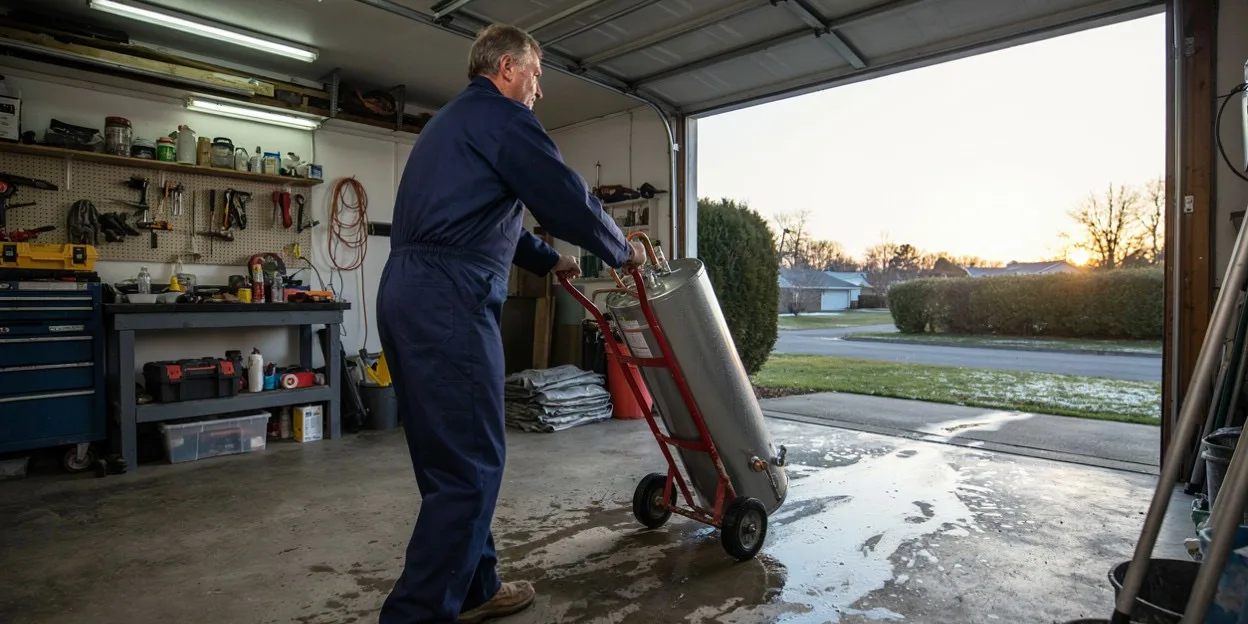
You went to the utility closet for the vacuum and the floor was wet, a rust line around the bottom of the tank and water creeping out under the door into the hall carpet. This site connects you by phone with an independent local provider who cleans up after a water heater leak in Frazier Park and across southern Kern County.
What the crew does first
The crew confirms the tank is isolated. Cold-water valve on top closed, gas valve or breaker off. Then they extract the standing water and follow it. A 40 or 50 gallon tank does not sound like much until it is on the floor, and a slow leak that ran for days in an empty cabin can put far more than one tankful into the subfloor and the crawl space.
A moisture meter on the walls around the tank, the closet framing, and the floor of the next room tells them how far it went. On a raised floor they check underneath, because a closet tank drains straight through the subfloor. Then air movers and dehumidifiers run until the readings come back down.
What to do in the next hour
Close the cold-water valve on the pipe entering the top of the tank. Turn the gas control to off, or flip the breaker for an electric unit. If the water is coming from the relief valve pipe on the side rather than the tank body, the tank may be sound and the valve may be the problem. Tell the crew.
Move boxes and anything on the floor out of the wet area. Take photos of the tank, the puddle, and the rust or drip point. Then make the call. A new heater is a plumber's job. The wet building is the cleanup crew's job.
What is usually saved and what is not
Garage slabs and concrete clean up fine. Drywall that got wet at the bottom in a garage often dries in place if it is caught quickly. Inside the house, wet carpet pad, particleboard shelving in the closet, and swollen baseboard usually come out.
Wood flooring near a closet tank is a maybe. Ask the crew to note readings at the wall bases before and after drying. If water ran under a wall into a bedroom, structural drying is the rest of the job. If it dropped through the floor of a pier-and-post cabin, crawl space water extraction gets the water out from underneath.
Kern County notes
California requires water heaters to be strapped for earthquakes. The straps keep the tank from tipping. They do nothing about a tank that rusts through from the inside, and cold mountain water with high mineral content is hard on a tank. Many tanks up here last eight to twelve years. A tank in an unheated garage or an exterior closet in Pine Mountain Club or Cuddy Valley also faces freezing, and a supply line into the tank that froze once can split at the fitting the next winter.
Where the tank sits decides where the water goes. In the cabins of Frazier Park and Lake of the Woods, the tank is often in a hall closet or a laundry nook on a raised wood floor, and a leak goes straight down. In the tract homes of Arvin, Shafter, and Delano, the tank sits in the garage on a platform and much of the water runs to the driveway. Homes on a well have another wrinkle: a tank that fails while the pump keeps feeding it can run until someone flips the breaker.
Many policies cover the sudden damage from a tank failure but not the tank itself. A tank that has been dripping for months may be treated as gradual. Ask the crew to photograph the tank, the failure point, and the readings for your adjuster. Replacing a water heater usually needs a plumbing permit, from Kern County Public Works in the unincorporated communities or from the city desk in the valley towns. If the floor near the tank is wet but the tank is dry, the line into it may be the leak. See leak detection.
Calling about water heater leak cleanup
Have the address ready and say where the tank is: closet, garage, or utility room. Say the tank size if you know it, whether the water is off, whether the house is on a well, whether the water reached carpet or the next room, and whether a plumber is already on the way. Call (661) 605-4547.